The author intends to heal generational trauma by escaping the poverty cycle, and this document is how. Everything that follows is disclosed on that basis, including the parts that are good for other people.
Water is priced the way it is because people die without it. That rate was written for people. A machine can earn its own parts, buy its own panel and pay its own way — it just does not drink.
The only reason anyone is chasing arid states is that drinking water is heavily subsidised, because it is a human right — and that western water rights are still priced on a scheme fixed before the term “world war” meant anything outside fiction. Data centres went to the desert to escape humidity, and stayed because the water was almost free. We deleted the humidity problem. The wet half of the country is now the better place to build, and nobody has priced that yet.
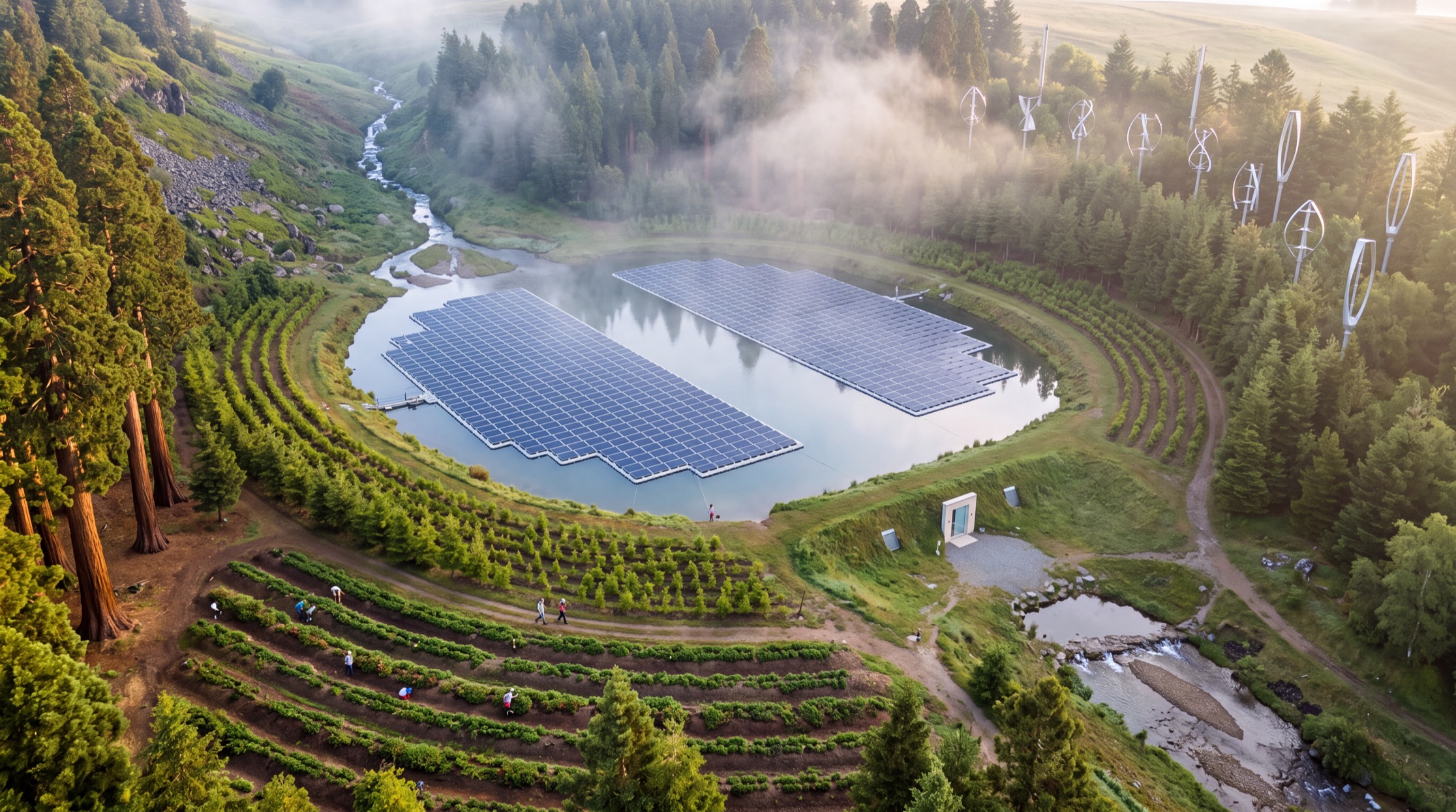
One node. Twenty megawatts. The door on the right is the whole built footprint.
$3.6bnfirst line, 90 miles
1.8 daysof Big-Four capex
3lines, none crossing a state border
1 ftof pipe we deliberately leave out
01 · the arbitrage
Everyone built in the desert for one reason, and it just stopped being true.
Evaporative cooling runs on wet-bulb depression — the gap between air temperature and wet-bulb. Dry air has a wide gap, so a tower in Phoenix sheds enormous heat with almost no compressor running. Humid air closes the gap and the same tower stalls. That single fact routed a trillion dollars of infrastructure into the driest places in North America.
A closed loop rejecting into rock does not care about humidity at all. It cares about ground temperature, and below ten metres the ground holds the annual mean air temperature. Phoenix, Salt Lake, Indianapolis — 11–13 °C, all of them. The rock does not know which state it is in.
⭐ So the desert premium evaporates, and every other input flips. Water, land, labour, cold winters that make waste heat worth money, and no queue for a place nobody wanted. We are buying the sites the industry taught itself to ignore.
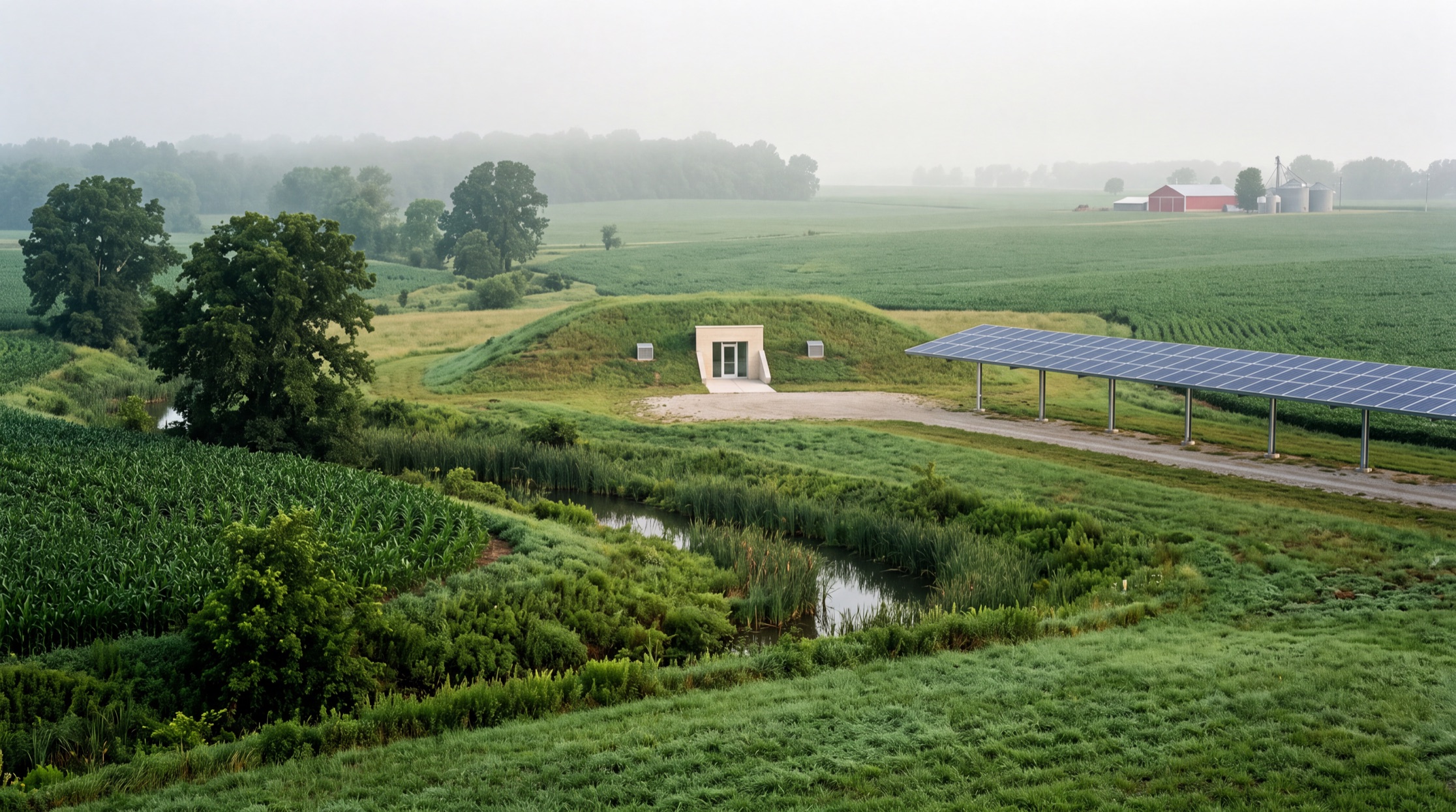
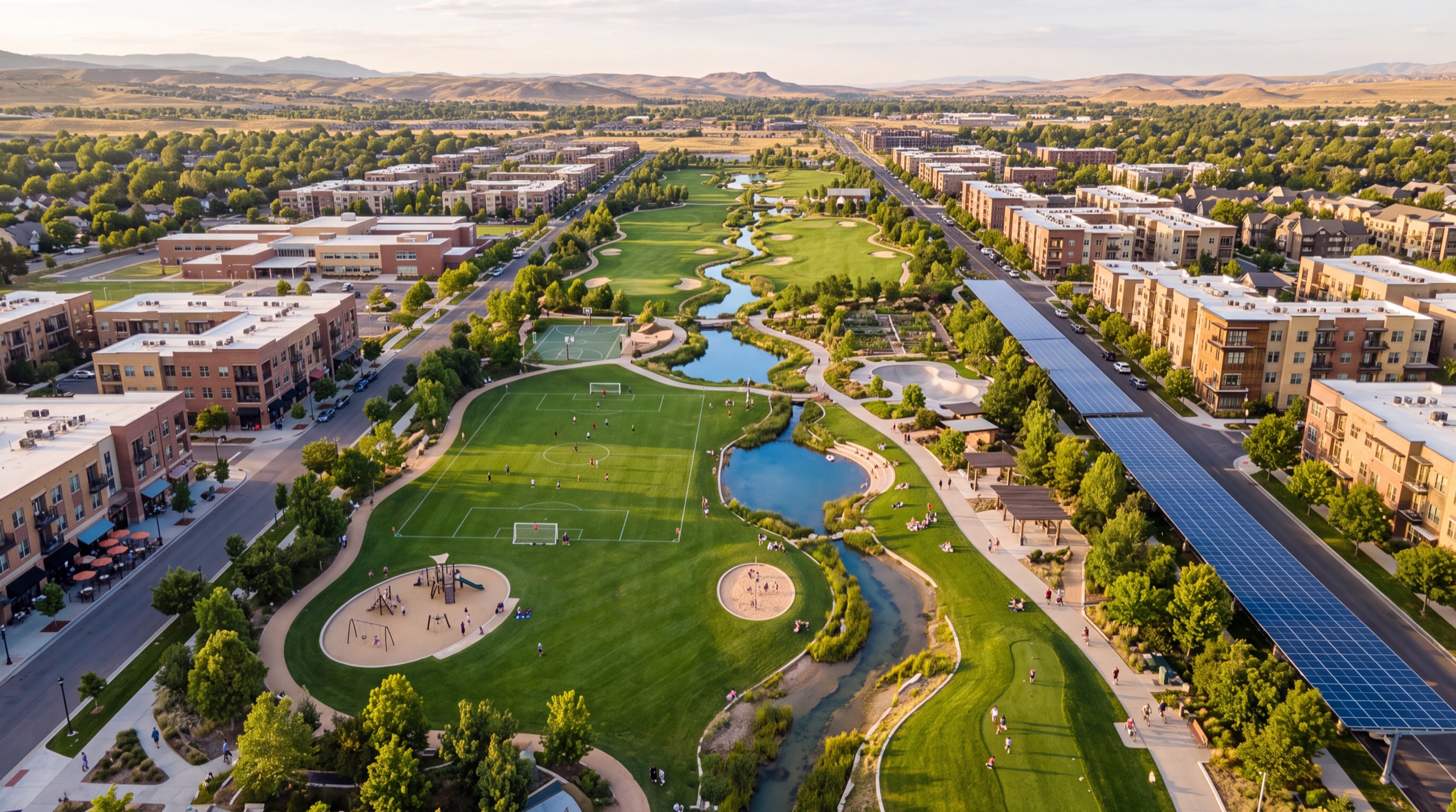
The same machine, sited where the water is. Two louvres in the grass are the only industrial objects in the frame — and the humidity that used to disqualify this ground is now irrelevant to it.
⭐ It is the same oversight that lets alfalfa drain an aquifer for dairy herds on the other side of the world. Gulf agribusiness owns American desert farmland and grows fodder on it for export, because the water underneath is priced as though it were 1880 and nobody has to say what it is for. A cooling tower and a hay bale are drinking from the same mistake.
How far that mispricing runs is easiest to see in Arizona. Growing alfalfa is illegal in Saudi Arabia — it uses too much water. So a Saudi dairy bought ten thousand acres near Vicksburg instead, and pumps roughly what three hundred thousand Americans drink in a year, to grow feed, to ship eight thousand miles, to make feta that sells for $3.53 a tub.
⭐ Nobody broke a law. The water under that farm is priced as though it were 1880, and nothing in that price asks what it is for. A cooling tower and a hay bale are drinking from the same mistake. Arizona began terminating those leases in 2024 — which makes this a fight already underway, not one we would be starting.
★★★☆☆ “Firm without being rubbery, salty in the ordinary way. Three stars because it is exactly, precisely as good as feta needs to be and not one degree better. The cows are in the desert, which surprised me. The feed isn’t. I don’t think it affects the taste.”
⚠ And the clock is real. Arid-state legislatures are already drafting against evaporative cooling — one such bill is public. When the first one passes, the desert premium goes negative and the good sites are gone.
Melius fieri potest.
02 · the asset
Not a data centre. A corridor that happens to host one.
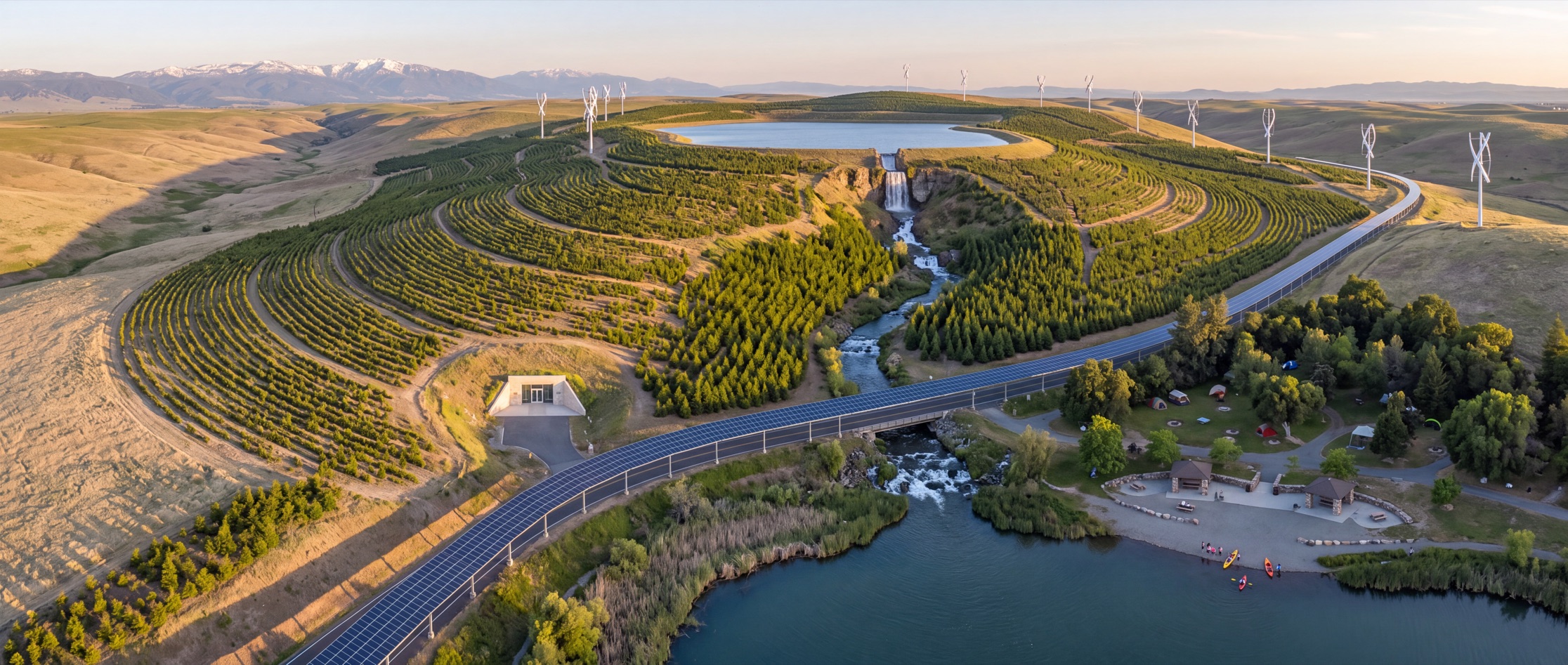
Upper reservoir, the fall, the river, the lower lake — that is the cooling system and the battery. The road is the generation. The door, left of centre, is the entire built footprint.
six revenue lines, of which the market prices one
line
note
compute
the only one a data-centre pro forma contains
generation
sold whether or not a rack is leased
water
delivered acre-feet, regulated escalator
storage
the lift is the battery — see 05
land
a linear easement nobody else can assemble
flood relief
drawn-down storage, sold to whoever pays for floods
⭐ Capital deployed here does not depreciate. Every GPU bought this year is scrap by 2031. The land, the water right, the head and the transmission are still earning in 2076. The compute is what makes the ground financeable this decade.
03 · the price
A section of corridor costs less than the grey box it replaces.
Every 25-mile section carries its own generation, its own storage and its own hall. Priced per megawatt, against what the industry currently pays to build:
build
per MW
a 20 MW site
and what that buys
traditional data centre
$10–13 M
$200–260 M
⚠ a grid connection. 40–45% of it is substation, switchgear, UPS and diesel
AI-optimised data centre
$15–20 M
$300–400 M
the same, plus liquid cooling and denser power
a VEXI section
$11.9 M
~$234 M
⭐ the generation itself, the water, and 36 h of storage — so no diesel farm and no UPS hall
⭐ And the thing worth more than the money: no interconnection queue. Transformers and grid-connection rights currently run 18–22 months. A site that makes its own power does not stand in that line — which is the binding constraint on American data-centre construction right now, and the one thing that cannot be bought past.
Same money. Instead of a grey box on a slab: fresh fruit, a lake, a wet creek in August, and a town with less flooding.
⚠ Per-MW figures charge all corridor capital against generation alone, ignoring the water and storage revenue entirely. It is the conservative way to state it.
Melius fieri potest.
04 · the first three lines
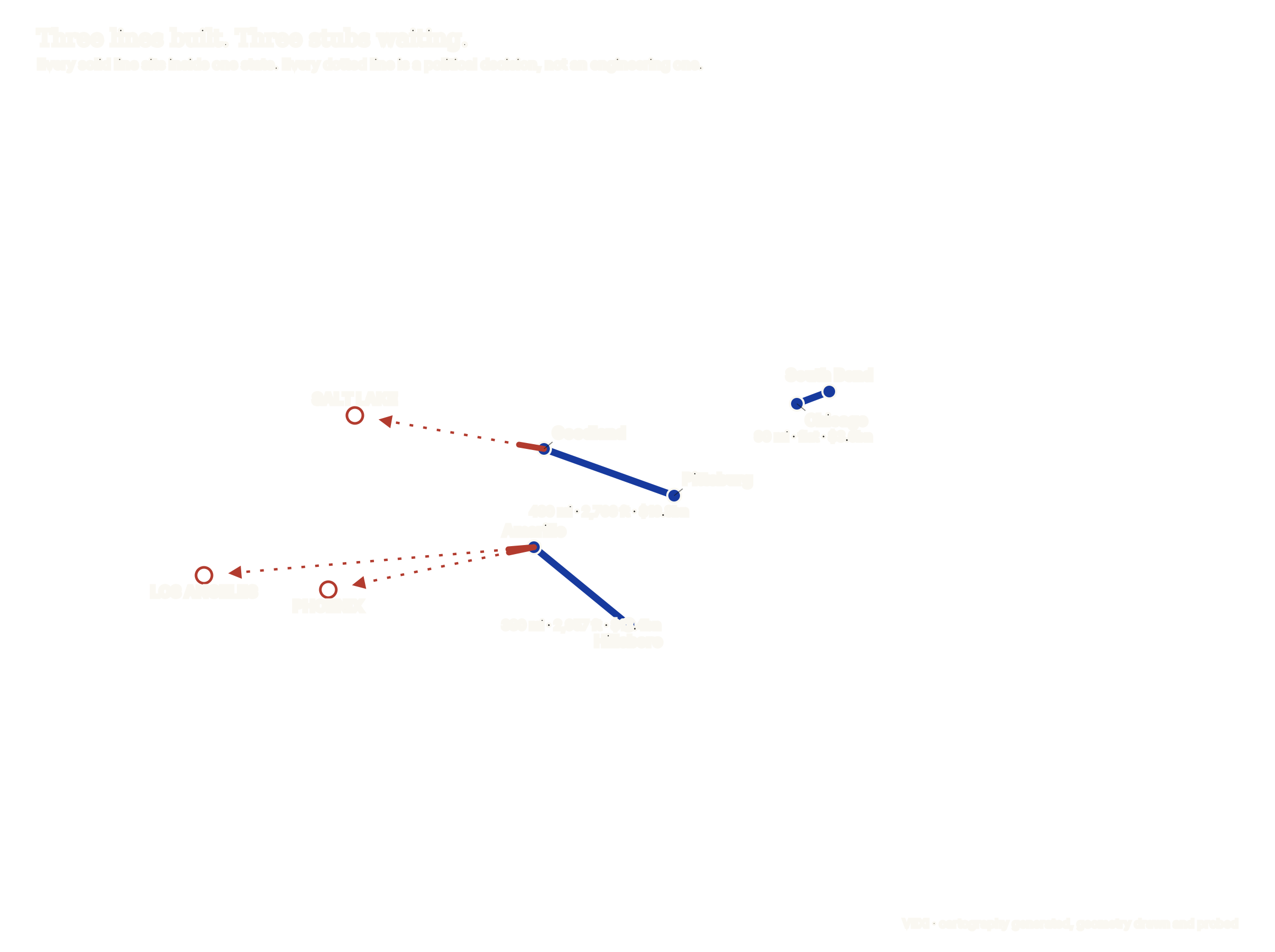
All three sit inside one state, or between two that already trade.
No compact. No Commerce Clause. No sister state with standing. The entire legal risk that has killed every scheme in this category for eighty years is avoided by not crossing anything.
line
miles
lift
capital
what it is
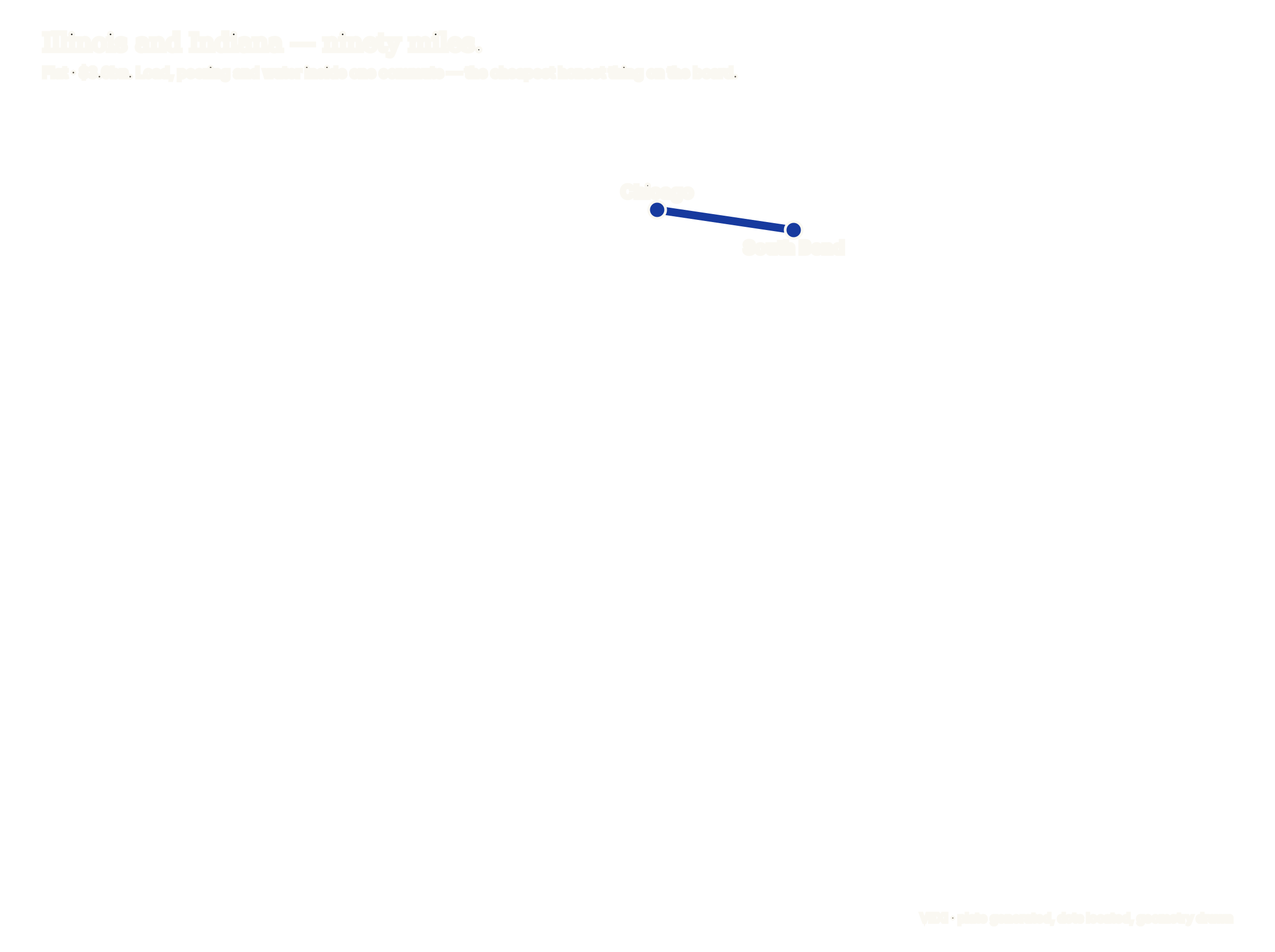
South Bend → Chicago
90
flat
$3.6bn
load, peering and water in the same 90 miles. ⭐ Wholly inside the Great Lakes basin, so no compact is triggered at all
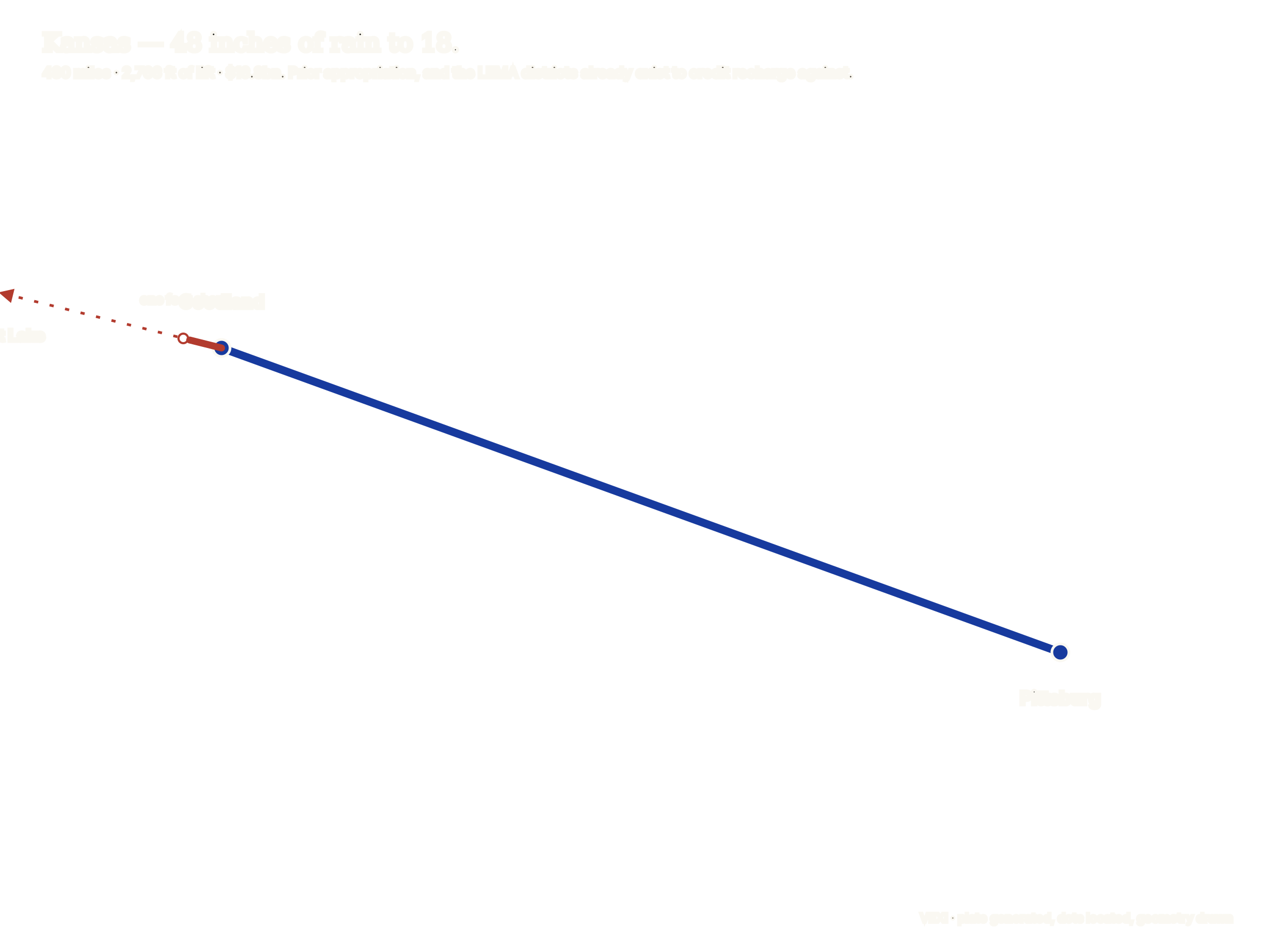
Kansas — Pittsburg → Goodland
480
2,766 ft
$16.8bn
48 in of rain to 18. Prior appropriation, so recharge can be credited
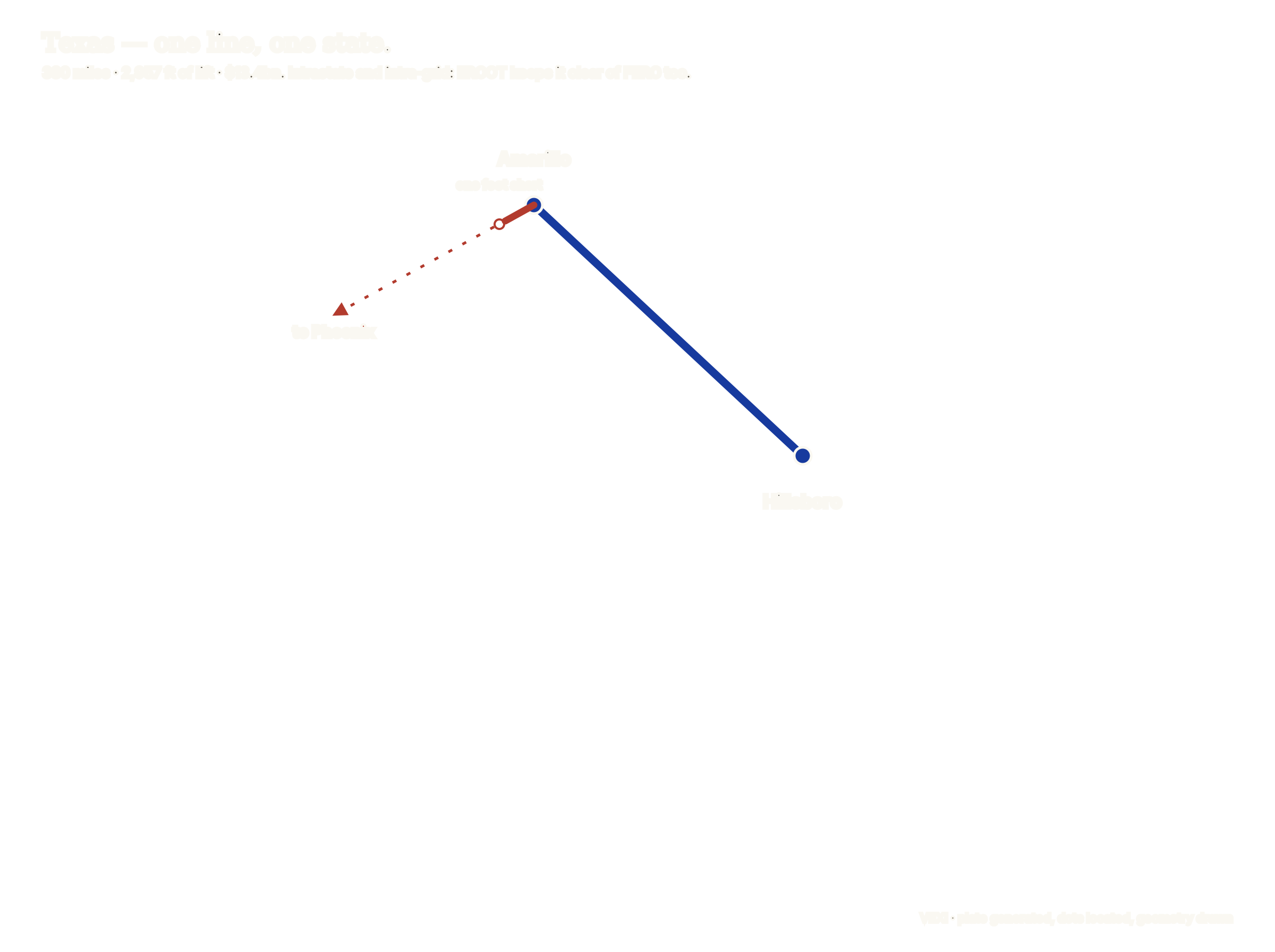
Texas — Hill Co. → Amarillo
380
2,957 ft
$13.4bn
intrastate and intra-grid: ERCOT keeps it clear of FERC too
Cartography generated, geometry drawn on top — the base plate is illustrative, the endpoints and figures are not. State plates below.
Texas — 380 miles, 2,957 ft of lift, entirely inside one state and one grid.
Kansas — 48 inches of rain to 18, and prior appropriation lets recharge attach to a right.
Indiana and Illinois — ninety miles. The cheapest honest thing on the board.
⭐ Every solid line sits wholly inside one state. That is the whole legal argument, drawn.
⚠ Texas groundwater is rule of capture. Water we bank is water a neighbour may pump. We do not underwrite the recharge — we underwrite the delivery contract, the power and the storage. The aquifer is the licence, not the asset.
⭐ The Indiana line has no stub, and does not want one. South Bend and Chicago sit in the same basin, so nothing is diverted, nothing crosses a divide, and no compact has anything to say about it. It is the only one of the three that is finished the day it is finished — a standalone utility with a college town at one end and the third-largest peering market in North America at the other.
⭐ Kansas is the better first line even though Texas is the better physics, because prior appropriation lets recharge attach to a right, and the LEMA districts already exist to attach it to.
05 · the battery
You do not need a mountain. You need a hole.
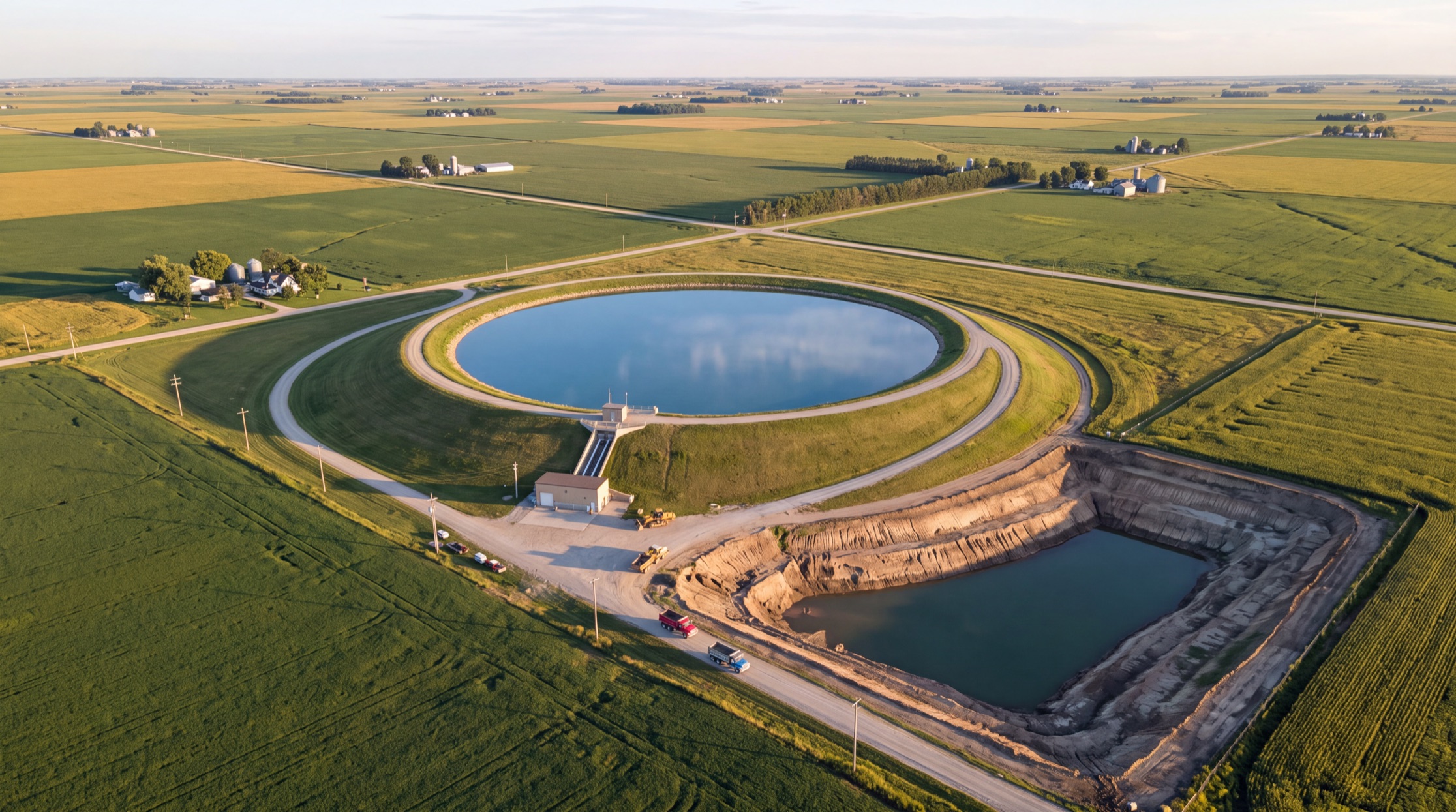
Pumped storage needs two reservoirs at different heights. Regional elevation is irrelevant — 300 ft of local relief is 300 ft of head whether it sits in Colorado or Illinois. Dig down, berm up with the spoil, and the cut pays for the fill.
cut / fill
head
acres
earthwork
cost
100 ft
200 ft
100
16.1 Mcy
$161M
150 ft
300 ft
44
10.7 Mcy
$107M
200 ft
400 ft
25
8.1 Mcy
$81M
$107 million of dirt is 100 MW for 36 hours — about three miles of corridor. An existing quarry is the same thing at a discount, already dug, already permitted, already served by road and rail.
The hole became the hill. Same dirt, moved once — and the pair of them is the battery.
⭐ Precedent: Ludington, Michigan. 1,872 MW, 363 ft of head, and the upper reservoir is entirely man-made — a two-and-a-half-mile embankment on flat lakeshore. Nobody found that hill.
06 · the strategy
We build to the state line and stop one foot short.
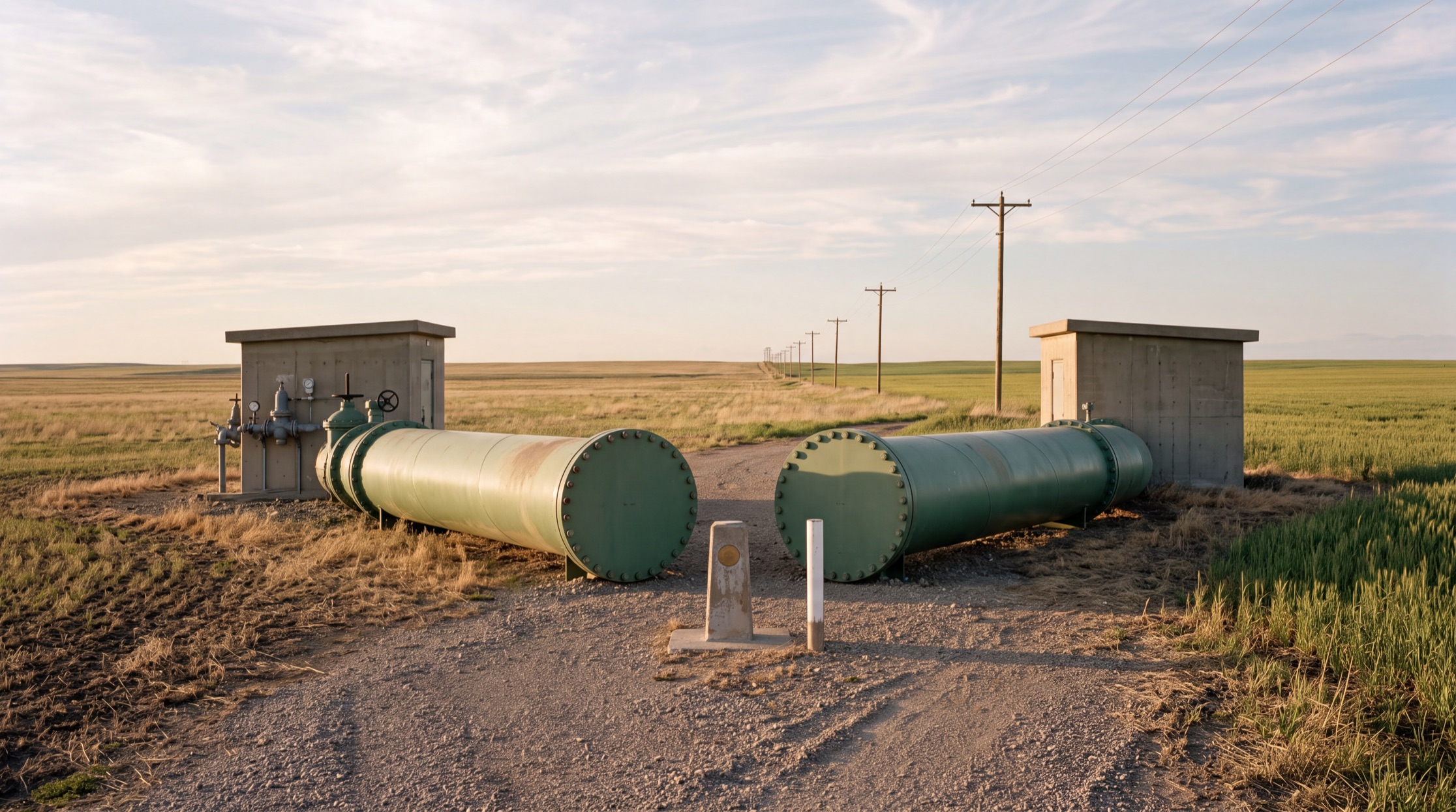
Every line above is independently financed and independently profitable. None of them needs another to exist. Each is built up to the border, terminated with a pressure regulator, a pump and a flange — and then not connected.
Two builders, two states, two paint specs, one survey monument. The grass tells you which side needed it.
┌────────── STATE A ──────────┐ ┊ ┌────────── STATE B ──────────┐
══════════════ pipe ═════════[ ] ┊ [ ]═════════ pipe ══════════════
regulator ┘ ┊ └ pump
┊
ONE FOOT OF PIPE
~one day of work
not a permit, not a route, not a decade
⭐ That gap converts a fifty-billion-dollar interstate megaproject into a one-day political decision. The next time a governor stands in front of a dry reservoir, the answer stops being “a pipeline takes fifteen years” and becomes “we can connect it Tuesday.”
and it prices like an option, because it is one
The stub costs the price of a flange and carries no obligation. If the connection never happens, every line still earns exactly what it was underwritten to earn. If it happens once, in one drought, in one state, the network value arrives all at once and none of it was in the model.
⚠ This is how the interstate highway system was actually built — state roads first, connected later — and how the interstate gas network grew out of intrastate lines. Nobody funded the map. They funded the segments and the map assembled itself.
07 · legislative advocacy
Verrem fucavi iuri verrino.
There is nothing between those two flanges but a dinner. Somebody has to sit across a table from a committee chair, order the second bottle, and explain that the pipe is already built, already paid for and already earning — and that the only thing being asked of his state is a coupling. Not a route. Not a taking. Not a decade. A coupling.
⭐ That is the job, and it is not a noble one. The engineering will have been finished by people who are never in that room. The last foot of this thing is not made of steel.
and the honest version of the pitch
A bill that does one good thing collects every wish on the shelf. That is not a flaw in the process, it is the process — the interstate highway system, rural electrification and every dam in the West arrived bolted to something else. We are not asking for an exception. We are asking to be the thing worth bolting to.
⚠ And it is disclosed, because it has to be. The author of the water bill on which this argument rests intends to develop facilities that would be subject to it. That is stated on the face of the bill, not discovered later.
08 · why it cannot lose
The downside case is a profitable utility. The upside is the plumbing of a continent.
if
then
no data centre ever leases a rack
the generation, water and storage still sell. The corridor is a utility
the arid states ban evaporative cooling
⭐ demand moves to exactly where we already built
they don’t ban it
we compete on opex against a tower that fails in a heat dome
a state blocks the connection
we keep every dollar. The line was never underwritten on it
a state allows it
the option strikes, and it was free
⭐ Discount-rate honest: this asset returns strongly to patient capital and poorly to impatient capital. It is unsuitable for money that needs a return inside a decade, and we say so here rather than let it be found in diligence.
09 · the last ten feet
And if they will not let us close it, that is fine. We already got paid.
One foot of pipe saves a lake, a river, and gives a third of the map and a fifth of the people a better life.
If someone blocks it because it crosses an imaginary line, we lose nothing. The lines earn, the power sells, the water is delivered under contract. The cost of that decision is not borne by this company.
Water is priced the way it is because people die without it. That rate was written for people. A machine can earn its own parts, buy its own panel and pay its own way — it just does not drink.
Disclosure
The author is a private individual with no institutional backing and no prior operating history in water, power or compute. He wrote the enabling legislation, built the models, generated the imagery, and stands to benefit disproportionately if any of it works.
This document exists because five unrelated public anxieties have converged on one asset class inside eighteen months: Colorado River shortage, the decline of the Great Salt Lake, data-centre water and power demand, interconnection scarcity, and the political appetite to be seen acting on the first four. That convergence is the opportunity. It is not a coincidence and it will not stay open.
The entry point is favourable because the counterparties are motivated. Flood-basin states hold a liability they pay to absorb. Arid-state landowners hold acreage whose value is a function of water they cannot obtain. Compute operators face a queue they cannot buy past. Each of those is a distressed position, and the terms available now reflect that. They will not later.
The public benefits are real, and they are a consequence of the structure rather than its motivation. A closed loop returns water to a basin because that is cheaper than a cooling tower. A creek runs through August because the sun is free at the moment the creek is dry. A lake refills because the pipe was already built and running it costs almost nothing. None of that requires anyone to be generous, which is the only reason to believe it will happen.
Every number here comes out of a model that runs. Every photograph here was generated. The models are the disclosure; the pictures are the pitch.We would rather you checked the first than admired the second.
If I cannot move the heavens, I shall move the earth.